

Myla
34Jordan
- Age:
- 26
- Bust Size:
- B
- Price · 1h:
- HK$ 2,100
- Place of Service:
- Outcall
Discretion matters on both sides of a booking. Hong Kong's privacy law gives you rights over your personal data, and since 2021 doxxing and sharing intimate images without consent have been crimes. Here is what that means for clients and for escorts.
By the Star Escort HK team Published
Discretion is part of every good booking. Clients don't want a meeting to follow them home, and women who advertise need their work kept apart from the rest of their lives. Hong Kong has a privacy law that helps both: the Personal Data (Privacy) Ordinance, usually called the PDPO. Since 2021 two sets of crimes have been added for the worst abuses, doxxing and sharing intimate images without consent.
This guide explains what the law gives you, where its limits are and what to do if someone threatens to expose you. It is written for both sides of a booking, because the same rules protect both.
The PDPO (Cap. 486) protects personal data: information about a living person from which that person can be identified, such as a name, a phone number, a photo or a chat history.
It applies to every "data user", meaning anyone who decides how personal data is collected, kept or used. That includes websites, hotels and banks, and it includes an individual who keeps details for her work. The law is enforced by the Privacy Commissioner for Personal Data (PCPD). The PCPD handles complaints, can order a data user to put things right and, since 2021, can investigate and prosecute doxxing itself.
Breaking a principle is not a crime in itself. The PCPD can serve an enforcement notice that tells the data user what to fix, though, and ignoring that notice is an offence: up to HK$50,000 and two years in prison on a first conviction.
You can ask any data user whether it holds personal data about you, and for a copy. This is called a data access request. Make it in writing, in English or Chinese, on the PCPD's form OPS003, because a request on any other form can be refused.
The data user then has 40 days to send you the data, or to refuse in writing and give its reasons. It may charge a fee, but only a fee that is not excessive: the cost of finding and copying your data, not its legal bills or office overheads. Where the data also identifies someone else, it must still send what it can and black out the rest.
If the copy shows something wrong, you can ask for a correction, free of charge. The data user has 40 days to correct it and tell anyone it passed the data to in the past year, or to refuse in writing with reasons.
Here Hong Kong differs from Europe. The PDPO gives no general "right to be forgotten", and the PCPD has said so itself. Instead, every data user must delete personal data once it is no longer needed for the purpose it was collected for. A request to delete an old account or old details usually works for that reason. It rests on the data user's duty, though, not on a right you can enforce in every case.
Unless a law allows it, nobody can force you to give your Hong Kong identity card number, let alone a copy of the card. The PCPD's code of practice tells organisations to use less intrusive options where they can, and its guidance warns against collecting copies of ID cards through messaging apps or phone photos. A business may decline to deal with you if you say no, but it cannot make you hand the card over.
Never send a photo of your ID card or passport to someone you met online. It is exactly what identity thieves and blackmailers are looking for.
The PDPO exempts data kept only for personal, family or household matters. Details kept for work fall outside that exemption, so the six principles apply to anything you collect from clients. Following them is also simply good safety:
Your own photos deserve the same care. Photos on Star Escort HK may carry the site's watermark, and if your photos or details turn up in a profile that isn't yours, the report button on that profile starts a review for removal.
Since 8 October 2021 it has been a crime in Hong Kong to disclose someone's personal data without their consent, either intending to cause them or their family "specified harm" or not caring whether it does. Specified harm means:
The penalty depends on what follows. When no harm actually results, the maximum is a fine of HK$100,000 and two years in prison. When harm does result, it rises to HK$1,000,000 and five years.
For our readers, this covers the obvious cases. A client who posts a woman's real name, home address or family details to shame her commits it, and so does anyone who posts a client's name, workplace and photos to "expose" him. The first person convicted under the law, in 2022, had posted the personal data of a woman he had dated briefly. He was jailed for eight months.
The PCPD can also order doxxing content taken down by serving cessation notices on platforms in Hong Kong and abroad. By the end of 2025 it had sent 2,104 notices to 57 platforms, covering more than 33,700 posts, with a compliance rate above 96%. Doxxing can be reported to the PCPD's doxxing hotline, 3423 6666.
A separate law, also in force since 8 October 2021, covers intimate images. Each of these is a crime that carries up to five years in prison:
Three details matter here:
When a case is prosecuted, the court can also order anyone, in Hong Kong or elsewhere, to remove the images.
For a booking, the practical rule is simple: no photos or videos unless both of you agree beforehand, and nothing shared afterwards. Our terms of use say the same.
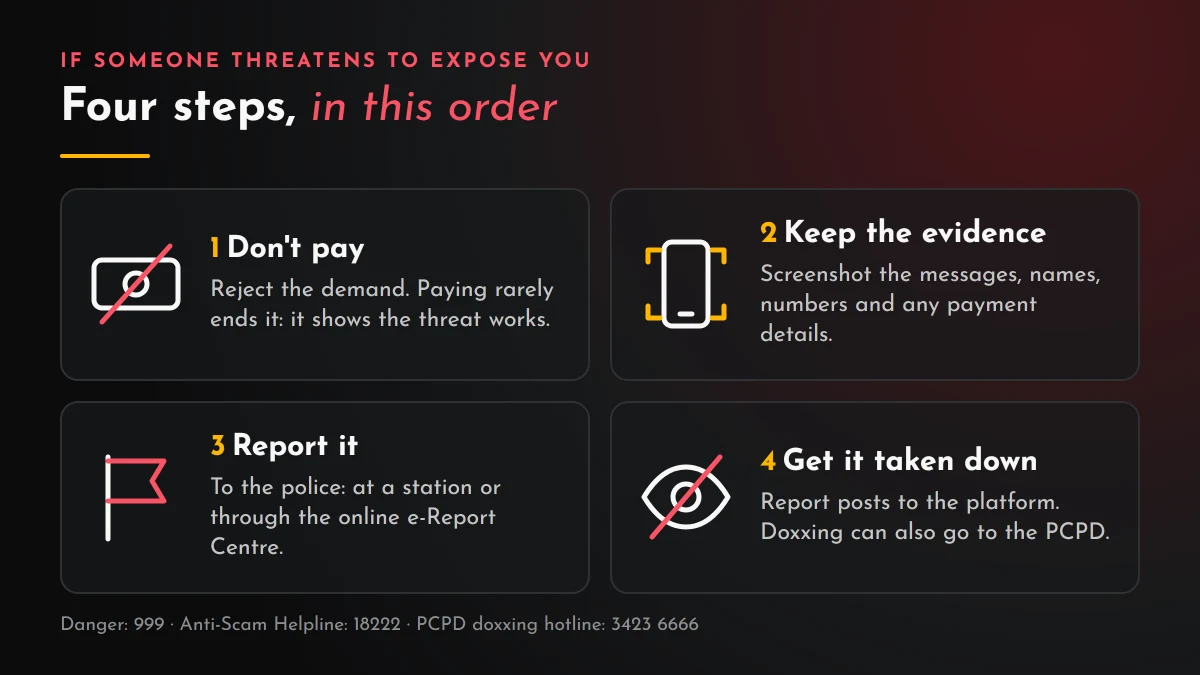
Blackmail is an unwarranted demand backed by a threat, such as "pay me or your wife sees these messages". Under the Theft Ordinance it carries up to 14 years in prison. It is also common. In 2025 Hong Kong police recorded 1,674 blackmail cases, and 1,312 of them started with a "naked chat" on a video call.
Blackmail targets both sides. Clients are threatened with exposure to their family or employer, sometimes by scammers posing as escorts. Women are threatened with being outed to family or landlords. The police advice is the same for everyone: reject any demand for money, keep a record of every message and report it.
Before you send money to anyone, you can check their phone number or account on Scameter, the police's free scam search engine. A clean result is not a guarantee, but a flagged one is a clear warning.
A privacy guide would be hollow if it skipped our own practices, so here they are in short. The full version is in our privacy policy.
| Problem | Who to contact |
|---|---|
| You are in danger right now | Police: 999 |
| Blackmail, a scam, or a threat to publish images | Any police station or the police e-Report Centre; advice from the Anti-Scam Helpline 18222, 24 hours a day |
| Your personal data posted to harm you | PCPD doxxing hotline: 3423 6666 |
| A business mishandling your data or ignoring your access request | PCPD enquiries: 2827 2827; complaints must be made in writing |
| Checking a phone number or account before you pay | Scameter on CyberDefender |
| Support after image-based sexual abuse | RainLily helpline: 2375 5322 |
| Your photos or details in a profile on Star Escort HK | The "Report profile" button on that profile |
She can ask, and you can say no. Nobody can force you to hand over your identity card number or a copy of the card unless a law allows it, and the PCPD advises against collecting ID copies through messaging apps. If she wants to screen you, offer something less sensitive, such as your name and a reference.
Not to harm you. Posting your personal data without consent to harass, threaten or intimidate you is doxxing, a crime that carries up to five years in prison. Publishing an intimate image of you without consent, or threatening to, is a separate crime with the same maximum.
Hong Kong has no general right to be forgotten, but every data user must delete personal data it no longer needs. On Star Escort HK you can delete your account and what you published from your account settings. For other sites, ask in writing, and complain to the PCPD if they keep data they have no reason to keep.
Not secretly. Recording someone in a private situation without their knowledge is voyeurism, which carries up to five years in prison, and publishing the recording is a further crime. Even a recording made with consent can't be shared without consent.
No. Reject the demand, keep every message and report it to the police. Paying rarely ends it.
This article is general information about Hong Kong law as it stood in November 2026, not legal advice. The government and the PCPD are reviewing the PDPO, and proposals such as mandatory notification of data breaches have not yet become law, so check the PCPD's website for changes. For advice on your own situation, speak to a lawyer.
Sources: Personal Data (Privacy) Ordinance (Cap. 486), Crimes Ordinance (Cap. 200), Part XIIAA, Theft Ordinance (Cap. 210) and the Privacy Commissioner for Personal Data. Read next: Hong Kong escort laws: what clients need to know.
Jordan

Lantau

Sha Tin

Hong Kong Airport